Medical Skincare Icon Collection
A Designer’s First Look: Clean, Clinical, and Quietly Confident
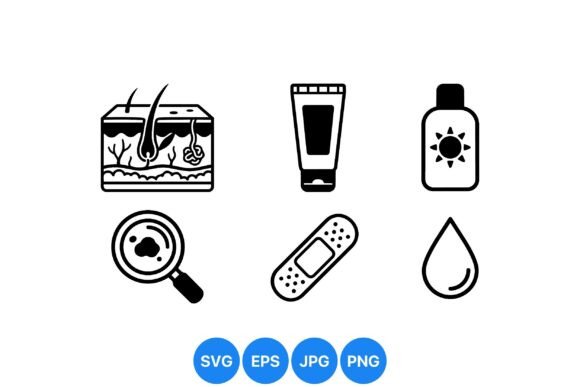
Opening Medical Skincare Icon Collection feels like stepping into a well-lit dermatology office—calm, precise, and uncluttered. These aren’t playful skincare doodles or bubbly wellness motifs. They’re black-and-white vector icons built around anatomical clarity (that skin cross-section with hair follicle) and functional symbolism: magnifier, bandage, water drop, and minimalist skincare product silhouettes. The mood is professional but approachable—ideal for practitioners, boutique spas, holistic estheticians, or even mindful skincare makers who want quiet authority over loud trends.
Where This Collection Fits in Real Embroidery Work
Last week, I prepped a custom embroidered tote for a local esthetician launching her new “Skin Science” workshop series. She needed something that said *expertise*, not *emoji*. I tested Medical Skincare Icon Collection on a natural linen tote using medium-weight cutaway stabilizer and 40-weight rayon thread. The skin cross-section icon—scaled to 2.5 inches wide—stitched cleanly: the follicle detail held, the outer skin layer read as a confident satin stitch border, and the water drop retained its subtle curve without collapsing. It looked handmade, yes—but also intentional and grounded.
This collection shines on items where clarity matters more than charm: sweatshirt chest logos for med-spa staff, baby onesies for pediatric dermatology practices (think tiny bandage + water drop combo), aprons for clean-beauty formulators, and pillow covers for post-procedure recovery kits. It also works beautifully as an embroidered patch—clean lines translate well to twill backing and consistent stitch density. For Etsy sellers, it’s a smart asset for digital embroidery files bundled with printable mockups: buyers can preview how the magnifier icon looks on a cream tea towel or how the bandage symbol reads on a navy cap.
What Holds Up—and What Needs Extra Care
Medical Skincare Icon Collection performs best when scale and surface align. On smooth, stable fabrics like midweight cotton twill, poplin, or quilting cotton? Excellent. On textured canvas or looped terry? The fine lines of the hair follicle or inner magnifier lens may soften—so test first. On stretchy fabric like lightweight jersey? Use tear-away + light cutaway stabilizer and reduce stitch density if your machine allows; otherwise, stick to flat panels (like a tote base or apron pocket).
Small hoop sizes (under 4x4") are doable—but avoid cramming the full skin cross-section into tight spaces. Instead, use individual elements: the water drop alone makes a refined baby embroidery motif; the bandage icon scales down to 1 inch without losing legibility. On dark fabric, stick with white or light gray thread—no need for metallics or variegateds here. The design’s strength is its restraint, not embellishment.
Curved surfaces—like caps or curved pillow edges—require slight repositioning of the magnifier or bandage icons to keep proportions honest. And while the vector origin suggests crispness, remember: embroidery interprets line weight differently than screen display. That delicate inner outline in the skin diagram? It’ll become a narrow satin stitch—not a hairline vector stroke. So check small details at actual stitch-out size, not just on-screen zoom.
Design Notes Every Embroiderer Should Run Through
- Test on scrap fabric first—especially if stitching on blends, textured weaves, or dark backgrounds.
- Review stitch density before finalizing: high-density fill areas (like the skin cross-section’s dermis layer) may benefit from reduced density on lightweight fabrics.
- Confirm hoop size compatibility—some icons are optimized for 4x4", others comfortably fit 5x7". Don’t assume uniform sizing.
- Inspect corners and junctions: sharp angles (e.g., where the magnifier handle meets the lens) should stitch cleanly—not bunch or skip.
- Try black-and-white mockups before choosing thread colors—this collection’s power lies in contrast, not hue.
- Compare light vs. dark fabric backgrounds visually and physically—the water drop icon reads differently on oatmeal vs. charcoal.
- Use proper stabilizer: cutaway for knits and wearables, tear-away for stable wovens and home goods.
- Verify licensing before selling finished products or bundling the Medical Skincare Icon Collection as part of a commercial embroidery file pack.
How It Shapes Perception—Beyond the Stitch
Using Medical Skincare Icon Collection doesn’t just add decoration—it signals care in curation. A client receiving a personalized gift (say, a lavender-scented pillow cover with the water drop + bandage icons) doesn’t just see “skincare.” They feel reassurance, science-backed calm, and attention to detail. For craft business owners, that builds trust faster than a generic leaf or heart icon ever could.
On Etsy listings or boutique shelves, this collection elevates perceived value: it reads as specialty design assets, not clipart. Buyers recognize intentionality—whether they’re purchasing a ready-made embroidered patch or licensing the digital embroidery file for their own production. And because it avoids trend-driven clichés, it stays relevant across seasons, holidays, and branding shifts. A holiday embroidery piece featuring the magnifier + water drop on a cream kitchen towel? Timeless. A wedding gift for a nurse-midwife couple? Thoughtful, not gimmicky.
Final Thought: Precision With Purpose
Medical Skincare Icon Collection won’t wow with flash—but it earns respect with consistency, clarity, and quiet confidence. It’s the kind of Illustrations set that grows more useful the longer you work with it: one icon becomes a signature, another solves a last-minute client request, and the whole set starts shaping your brand voice. Whether you’re an embroidery designer building a portfolio, an Etsy seller refreshing your craft business inventory, or a small shop owner sourcing design assets for custom apparel—it’s a grounded, versatile, and professionally resonant choice. Just remember: let the simplicity speak, stabilize wisely, and always stitch with intent.