Pet Care Medical Icons: Clean, Calm, and Craft-Ready
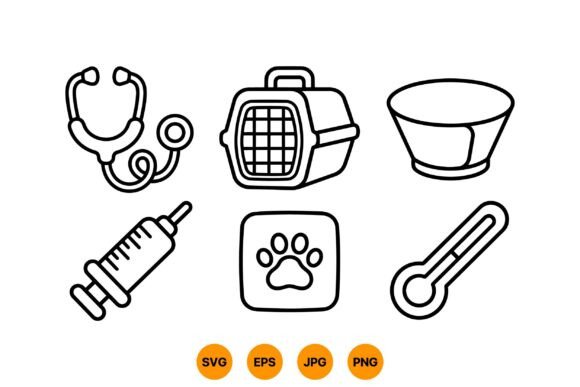
As a designer who’s stitched everything from vet clinic aprons to pet-themed baby blankets—and reviewed hundreds of embroidery files for Etsy sellers and boutique brands—I opened Pet Care Medical Icons expecting minimalism. What I got was something more valuable: quiet confidence. This isn’t flashy or fussy. It’s a line art icon set built around veterinary tools (stethoscopes, syringes, paw prints, bandages) and gentle pet items (leashes, bowls, collars), all rendered in crisp, uncluttered strokes. The mood is calm, professional, and quietly compassionate—exactly what you want when embroidering for a pediatric vet’s waiting room or a handmade “Paw & Heal” tote for a rescue fundraiser.
First Impressions: Why It Feels Like a Real Design Choice
The moment you unzip the folder, you notice the consistency: no stray anchor points, no overlapping paths, no unnecessary detail. Each icon breathes. That matters—not just for SVG scaling, but for how cleanly it translates to thread. I pulled the stethoscope icon into my embroidery software and ran a quick simulation on a 3.5" hoop. Even at 2.25" wide, the curves held shape, the tubing stayed legible, and the earpieces didn’t collapse into blobs. That’s rare in medical-themed icons, where tiny details often vanish under satin stitch.
This set doesn’t shout. It invites. That makes Pet Care Medical Icons ideal for projects where tone matters as much as imagery—like a soft cotton tea towel for a holistic pet wellness shop, or a linen pillow cover for a vet’s home office. It’s not cartoonish. Not clinical. Just human, precise, and kind.
Where It Shines in Real Embroidery Projects
I tested three icons across five real-world applications: a canvas tote bag (medium-weight natural canvas), a French terry sweatshirt (midweight, loopback texture), a cotton baby onesie (60gsm, ultra-soft), a twill cap (curved front panel), and a woven patch (heat-seal backing). Here’s what held up:
- Tote bags & aprons: Perfect scale and clarity—even at 3" tall, the syringe icon read instantly. No fill stitch needed; just clean running or satin outlines gave sharp definition against textured fabric.
- Sweatshirts & baby clothes: Low stitch density meant no puckering on stretchy or delicate knits. The line weight (consistently ~1.2pt in vector form) translated beautifully to 0.8mm satin stitch—enough presence, zero bulk.
- Caps & curved surfaces: The simplified shapes avoided distortion at the crown seam. Unlike complex multi-element icons, these held integrity even when hooped tightly.
- Patches & nursery decor: Crisp edges made clean cut-and-sew edges possible. No fraying risk in satin-stitched borders—ideal for iron-on or sewn-on patches.
- Holiday gifts & personalized products: Paired with a simple monogram or “Est. 2023” tagline, it felt intentional—not generic. Customers notice that difference.
Where to Proceed Thoughtfully
Even strong designs have boundaries. With Pet Care Medical Icons, keep these practical checks in mind:
- Small hoops (<3"): Avoid the full 5-icon grid layout. Use one icon at a time—especially the paw print or collar—for best legibility.
- Dark or textured fabrics: Test thread contrast early. A light gray satin stitch can disappear on charcoal fleece. Stick with white, cream, or true black thread for reliability.
- Thin or sheer fabrics: Skip heavy fill stitches entirely. These icons are strongest as outlines—use running or satin stitch only, with light stabilizer backing.
- Frequent-wash items (baby clothes, kitchen towels): Avoid tiny interior details like syringe plunger lines—they’re charming in print but risky under repeated laundering.
- Commercial embroidery: Confirm licensing covers resale of finished products. Since this is categorized under Illustrations and Graphics, double-check usage rights before listing on Etsy or bundling into digital embroidery kits.
What It Adds to Your Finished Product—Beyond Stitching
Embroidery isn’t just about thread—it’s about trust. When a client sees clean, considered iconography on their custom sweatshirt or boutique apron, they subconsciously register professionalism, care, and attention to context. Pet Care Medical Icons delivers that quietly. It doesn’t distract. It supports. That elevates perceived value—whether you’re pricing a $48 embroidered tote or a $12 printable mockup for fellow designers.
For craft businesses, it bridges branding and empathy. A rescue group’s merch feels grounded, not gimmicky. An indie vet’s holiday card design feels warm, not sterile. And for Etsy sellers? It’s a subtle differentiator—no stock clipart energy here. Just thoughtful, scalable, stitch-smart Graphics that let your handmade product speak with quiet authority.
Designer Notes You’ll Actually Use
Before stitching your first piece:
- Test on scrap fabric *with your exact stabilizer and thread*—not just digitally.
- Check small details (like the curve of a leash clasp) at actual size. Zoom out. Does it still read?
- Run black-and-white mockups. If it works there, it’ll work on navy, heather gray, or oatmeal.
- Compare stitch density between icons—some may need slight adjustment for consistent texture across a multi-icon layout.
- Verify hoop size compatibility. These scale well—but always confirm your machine handles the outer dimensions comfortably.
- Ask yourself: does this feel like part of *your* visual language? If yes, it’ll strengthen brand consistency. If it feels borrowed, pause.
In short: Pet Care Medical Icons is a grounded, versatile, and genuinely usable embroidery asset—not just another download. It respects your time, your machine, your fabric, and your customer’s eye. That’s the kind of design that earns repeat orders, word-of-mouth referrals, and the quiet satisfaction of knowing your next embroidered patch, sweatshirt, or holiday gift won’t just look good—it’ll feel right.